Saturday, June 27, 2009

A Must Read For Everyone

I just finished Mirrors: Stories of Almost Everyone by Eduardo Galeano. I am amazed at how much I learned from the book and how lyrical and engaging the entries were. Galeano takes on all of human history, and even a little pre-history, through short entries that engage with anything and everything: major events in human history, famous (and infamous) historical figures, great people whose names are now lost to history, etc. His populist approach and keen sense of history create a rich and engaging view of how things have changed over time but how discrimination, hate, and violence have always marred our actions. Heather and I were lucky enough to attend his reading the week the book came out a month or so ago. I have never seen the bookstore, Politics and Prose, so packed full of people (and they bring in some huge names for readings). Some excerpts from the book:

Brief History of Civilization

And we tired of wandering through the forest and along the banks of rivers.
And we began settling. We invented villages and community life, turned bone into needle and thorn into spike. Tools elongated our hands, and the hand multiplied the strength of the ax, the hoe, and the knife.
We grew rice, barley, wheat, and corn, we put sheep and goats into corrals, we learned to store grain to keep from starving in bad times.
And in the fields of our labor we worshipped goddesses of fertility, women of fast hips and generous breasts. But with the passage of time they were displaced by the harsh gods of war. And we sang hymns of praise to the glory of kings, warrior chiefs, and high priests.
We discovered the words "yours" and "mine," land became owned, and women became property of men and fathers the owners of children.
Left far behind were the times when we drifted without home or destination.
The results of civilization were suprising: our lives became more secure but less free, and we worked a lot harder.

Thales

Two thousand six hundred years ago in the city of Miletus, an absentminded genius named Thales liked to go for a stroll at night to gaze at the stars, and as a result he frequently fell into the ditch.
Perhaps by asking the stars, Thales discovered that death is not an end but a transformation, and that water is the origin and meaning of all life. Not gods, water. Earthquakes happen because the sea moves and disturbs the land, not becasue of Poseidon's tantrums. The eye sees not by divine grace, but by reflecting reality the way the river reflects the bushes on its banks. And eclipses occur, not because the sun hides from the wrath of Olympus, but because the moon covers the sun.
Thales, who had learned to think in Egypt, accurately predicted eclipses, measured with precision the distance of approaching ships on the high seas, and calculated the exact height of the Keops Pyramid by the shadow that it cast. One of the most famous theorems is attributed to him, as well as four more, and it is even said that he discovered electricity.
But perhaps his greatest feat was of a different kind: to live godless, naked of any religious comfort, never giving an inch.

The Loser

He preached in the desert and died alone.
Simón Rodríguez, who had been Bolívar's teacher, spent half a century roving Latin America on the back of a mule, founding schools, and saying what no one wanted to hear.
A fire took nearly all his papers. Here are a few of the words that survived.
  • On independence:
We are independent but not free. Something must be done for these poor people, who have become less free than before. Before, they had a shepherd king who did not eat them until they were dead. Now the first to show up eats them alive.
  • On colonialism of the mind:
Europe's know-how and the prosperity of the United States are for our America two enemies of freedom of thought. The new republics are unwilling to adopt anything that does not have their stamp of approval... If you are going to imitate everything, imitate orgininality!
  • On colonialist trade:
Some think prosperity is seeing their ports filled with ships - foreign ships and their homes turned into storerooms for goods - foreign goods. Every day brings another load of manufactured clothes, down to the caps the Indians wear. Soon we shall see little golden packages bearing the royal coat of arms containing 'newly processed' clay for children accustomed to eating dirt.
  • On popular education:
To make students recite by rote what they do not understand is like training parrots. Teach children to be curious so they learn to obey their own minds rather than obeying authorities the way the narrow-minded do, or obeying custom the way the stupid do. He who knows nothing, anyone can fool. He who has nothing, anyone can buy.

Criminology

Every year, chemical pesticides kill no fewer than three million farmers.
Every day, workplace accidents kill no fewer than ten thousand workers.
Every minute, poverty kills no fewer than ten children.
These crimes do not show up on the news. They are, like wars, normal acts of cannibalism.
The criminals are on the loose. No prisons are built for those who rip the guts out of thousands. Prisons are built as public housing for the poor.
More than two centuries ago, Thomas Paine wondered:
"Why is it that scarcely any are executed but the poor?"
Texas, twenty-first century: the last supper sheds light on the cellblock's clientele. Nobody chooses lobster or filet mignon, even though those dishes figure on the farewell menu. The condemned men prefer to say goodbye to the world with the usual: burgers and fries.

Saturday, June 20, 2009

Something to Consider

I came across this quote from I.F. Stone in The Nation a couple weeks ago:
"If you're going to be a newspaperman, you are either going to be honest or consistent. If you are really doing your job as an observer... it's more important to say what you see than to worry about inconsistency. If you are worried about that, then you stop looking. And if you stop looking, you are not a real reporter anymore. I have no inhibitions about changing my mind."
While I think the quote should be read daily by anyone in charge of informing the public (or hourly at Faux News), I think it can also be applied more widely. I am sure by now most people are aware of the psychological term 'cognitive dissonance', where people filter the information they receive to make it fit their current worldview, instead of letting their perspective evolve in light of new information.

It is a grave error to believe that anyone ever has all the facts or a monopoly on the ability to analyze information. I find that the most uninteresting people to talk with are the ones that have lost all curiosity and stick to ossified opinions that are out of touch with reality. I understand that we all have different backgrounds and are exposed to vastly different sources of information, both in terms of quantity and quality. This gives rise to the diversity of perspectives and opinions, many of which I cannot fathom. While I don't think we have to give credence to all opinions and perspectives, we must be aware that at some level a given person has built a world view that is at least somewhat internally reinforcing. Expecting people to change their mind over a core belief or an opinion that is central to that belief takes time and cognitive effort.

And, as one of my favorite professors said, "Everyone has the right to be a hypocrite."

Health Care is a Human Right

With all the discussion of health and health reform, some key facts have been overlooked and, for the most part, insufficiently examined in the debates. While there has been some acknowledgement of the high cost of treating chronic diseases, rarely is it raised that treatment of these diseases accounts for 75 cents of every dollar spent on health care in the U.S. This fact helps us understand that while coverage for everyone is a crucial and fundamental right, the goal of keeping down costs requires more acute awareness of where the money is actually spent.

Another key fact that is discussed infrequently is the high concentration of health care expenditures in a small population. A recent study found that five percent of Americans are responsible for nearly HALF of all health spending in a given year. An earlier study found that it was over half. Also, almost half of the U.S. incurs little to no health care costs and thus the other 50 percent make up about 95% plus of the health care spending. This concentration is interesting at other levels as well. The top 30 percent of spenders make up 90% of health spending; while the top 10 percent make up nearly 70%.

These statistics speak the need for a more holistic view of reform. Increasing quality, decreasing costs, and expanding coverage all are worthy goals but they cannot be goals divorced from the social reality of health care needs. Both studies find that the elderly are more likely to bear the burden of high expenditures. Also, they found that people with chronic conditions had much higher out-of-pocket expenses than average. Better, more cost-effective treatment is needed for these folks. Often their situation is compounded by the fact that they may reach their lifetime spending cap and lose coverage. In turn, due to pre-existing conditions clauses, they may have an extremely difficult time getting other coverage, and if they do it will be exhorbitantly expensive until they are so drained of money they can qualify for Medicaid.

All these factors indicate the importance of having a coherent, nationally focused health care reform. The reform must be tailored to meet the needs of different populations and levels of care. However, everyone should have to have insurance; at the very least, catastrophic coverage. It is in the best interest of the long term health of the American people and in the best interest of our financial well-being, both individually and as a society. People without insurance coverage that require medical treatment incur higher costs and are much more likely to face bankruptcy as a result. Of course, there must be subsidies to help those who would not be able to afford coverage themselves.

During the current health care reform I have continually been dismayed by the process and how easily many of those involved lose sight of the overall goals and the purpose reform serves. We don't need reform for the sake of reform. Sure the system is broken, but a patchwork solution will only push the need for a more significant reform off the radar for another decade or two. We have hard decisions to make. Until we face those decisions with a sense of history and an eye to the future, we will continue to create policy that only serves to line the pockets of those who are currently abusing the system.

Sunday, May 31, 2009

Simply Unconscionable

As many have probably heard by now, Dr. George Tiller has been murdered in his own church today, most likely by a right-wing extremist. Dr. Tiller happened to perform abortions, including some of the extremely rare late-term abortions in the U.S. Though abortion is legal, there are clearly many in America that would rather scare women and their doctors back into the dark ages in terms of reproductive care. Gruesome images of aborted fetuses, 24-hour surveillance of clinics, and websites dedicated to outing anyone who visit those clinics are only some of the scare tactics these nouveau-fascists use to intimidate and harass. Their callous disregard for human life around the world and laser-focus on abortion smacks of hypocrisy at best and mindless, savage hatred at worst. Their "pro-life" stance extends only to abortion, not to real issues that would save lives around the world or improve the lives of people suffering here in the U.S. 

Anti-choice activists lack of nuance and understanding is most clearly shown in their disdain for sex education and attempts to block any sort of abortion rights or access. There will always be the need for abortions. While the number will fluctuate over time, it has overall decreased significantly since the 1980s even as the U.S. population has increased rapidly. With better sex education and improved birth control methods, that curve is likely to keep declining. Women would much rather be able to use the variety of birth control methods to keep from getting pregnant rather than have to resort to abortion. Abortion is often the last resort of people who simple had no other option. Those with any empathy at all can imagine an infinite number of situations where a woman would not be able to access or utilize birth control. Lack of affordable birth control is one of the major reasons that the vast majority of abortions are received by poor and low-income women. Other countries handle this better by providing free access to birth control and training on how to use out. However, even the most effective birth control isn't fool-proof and accidents will happen. Women and their doctors should have all the tools available to make the right decision for them. This is not simply a matter of morality and common sense, this is a matter of women's basic human rights. 

Goodbye Ambush

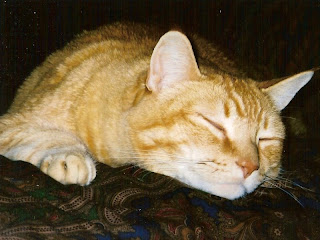
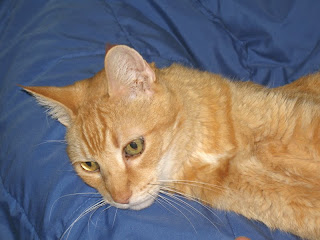
I got the news yesterday that the last of my childhood family pets was going to be put to sleep.  This was something my parents saw coming and they weren't sure he would make it through the summer. He still had a good quality of life up until the last few days, and for a cat that it is 17 years old that is pretty remarkable. I thought I would just jot done some of my many favorite memories about Bush (pronounced Boosch). Bush was the first and only pet that was actually my own. Even though he gave his affection to anyone and everyone, I always felt that he and I had a special connection. The world is a little less bright today knowing he is gone. 

When we first went to pick up he and Stormy, it was a bright summer day and we were excited to get them. The woman giving away the cats had about 5-6 kittens and so my mom let Aramie and I pick. All of the kittens, but one, were in the house and Aramie picked the cutest female gray tabby. The woman said that Radio (as they called him, due to the pointy bits of hair sticking out of the end of his ears) was out back up in a tree. While I knew the name would have to change, I also knew that sounded like my kind of cat.  I quickly went outside and climbed up the tree to where he was. Bush looked a bit stuck and was just at the edge my reach. I was able to coax him in a little and then snatch him and hand him down to the lady whose house it was. I was so excited and couldn't wait to get him home. 

From then on, Bush and Stormy were inseperable and were both extremely loving cats. Stormy was always gentle and would just come lay with you and never asked for more than she was given. Bush was the best combination of sweetness and stupidity. Very often you would hear a crash somewhere in the house and then have him run by you, either completely soaked or covered in a fine layer of dust or food. You would then find the source of the mess as some upended plant or some knocked over school project. 


Bush also took great joy in lying on your reading material. My dad would often sit on the floor and read the newspaper. We have a particularly great photo of him reading the paper one day with both cats lying contently on his back. Bush just wanted to be wherever his people were and wanted to let them know he was around.  Sometimes he would lie down on the newspaper (or on puzzles) because he loved the way it felt on his belly. 


He was always gentle and always loving. One of his favorite ways to show affection was to bump heads with you as you lie in your bed. And he had a hard head. Of all his behaviors, this is the one I will remember the longest and most fondly. It was just so cute and he always looked so happy after butting heads. He also had effective ways to wake you up if he wanted to. He would drive his nose between your neck and the pillow and lift, instantly waking you and then he would give a big smile and start purring like "Oh, you're up! What a coincidence, I am ready for attention!" He would also do this funny thing where he would open his mouth just a tiny bit and then push it against the back of your head. This also would wake you up with a start. 

He always decided to lay in strange places that didn't seem terribly comfortable. One of the strangest and cutest was on the back of my computer chair...when I was in it. It meant that he was actually lying across my shoulders but just happened to have the back of the chair there so he wouldn't fall. I would be working on papers, playing video games, or searching the internet; he would come and find me and take a nap. One thing about Bush lying on you is that he generated an ungodly amount of heat. He was like a walking heating pad. After lying on you for 10 minutes or so you had to make him change positions because he would get so hot. Also, as he got chubbier he got a lot heavier. When he would jump on the bed and start walking up, yowling the whole way, as soon as he stepped on you, you knew it. He had broad paws, but they still couldn't spread out the weight enough not to hurt. There were many times I thought he ruptured my spleen or broke a testicle after one carelessly placed step on his part. There were also many nights where I would wake up and see him standing on Heather's back. Heather would be kind of whining and trying to move, while still sound asleep, and Bush would be looking at me like "Is she going to stop soon?" 

While Bush could often just settle down and sleep sometimes, it was difficult to get him to settle. Once that would happen he would display some of his more annoying behaviors including whipping his tail and yowling. If you disturbed the position in which he was laying, he would began slapping his tail against the offending party in an irregular but consistent pattern. I would then try to hold the tail in my hand or tuck it under his body; both of which would cause to him to pull on his tail until it was free, either because I had fallen back asleep or because he won the tug-of-war. The yowling would come whenever he felt he had been slighted or was just generally confused. Heather and I have many shared memories of him loudly coming down the stairs into the basement and upon reach his destination going "Rawour! RAWOUR!" until he was acknowledged. Sometimes his behavior was bad enough or we needed sleep enough that we would push him off the end of the bed. At first he went fine. Then he began learning tricks to avoid this scenario. My personal favorite was a combination of Judo and pure speed. As I would start pushing him off the bed, Bush would shift his weight and dart up to the head of the bed and begin yowlying pitifully as if saying "It wasn't me! Just let me stay!"

Bush was the kind of cat that made people who hated cats to at least like him. There definitely was something doglike about his straightforward manner and often doofy personality. He liked weird things like having his hips slapped. He would hold on tight to the legs of the slapper and then would look up and cry when they would stop. It was by far his favorite type of attention. People always found it so hilarious because it seemed like such a strange behavior. Bush never withheld attention as other cats do, I don't think the thought ever even crossed his mind. He always gave all that he could and asked for as much attention as you could give him. 

Bush, you will be greatly missed. I can't imagine ever having another cat so smart at being so dumb and so easily lovable. We had you 17 years, since I was 9, and even that wasn't enough... Goodbye.

Sunday, May 17, 2009

A World of Gray

Contrary to the views of many, one of the biggest signs of political maturity, for me, is not moderation of your views over time but understanding that issues are much more complex than how they are presented. We often hear about issues at their lowest common denominator; with only buzzwords and soundbites to think about. People often discuss that the truth is somewhere "in the middle" between two perceived extreme positions. Often reality lies somewhere else completely. For nearly all issues of importance, there is no simple dichotomy of options. While most people lack the time or the incentive to come to fully understand the complexities of a particular issue, it is easy to understand how people increasingly talk at each other instead of to each other. When people are coming from completely different world views with large informational asymmetries, it is difficult to have a serious discussion.

Part of this problem lies with the current media, but also schools at all levels, and our political leaders also don't make things any better. The American people are often treated as less capable and intelligent as they really are. I have often agreed of the sentiment that Americans are too dumb and lazy to engage politically. Though I believe this premise is off target. It isn't that Americans are either dumb or lazy; or if they are, it isn't because of their individual actions alone. Just as there are large structural factors that lead to poverty and poor health, there are equally important factors that lead to a lack of intellectual sophistication or a deep engagement with civic, social, political, and economic issues. Often the causes interconnect and compound each others. Some examples include poor quality schools, acute and chronic childhood stress, penalization of the working class and the working poor, and virulent economic and social inequality. These are just some of the many forces that stunt development and hinder progress throughout the life-course.

Until we come to understand the social causes and the social reasons, we will continue to "blame the victim", as it were. Your average American has little real training in critical thinking or even basic empiricism, and this hinders their ability to sift through the noise and then incorporate information into a coherent worldview. Often, they don't have the time either. Probably most importantly, having a complex understanding of a particular issue or set of issues does your average citizen little in the long run. Unless it is something they do for work, the knee-jerk reactionary position they read in a flyer or hear on the radio is sufficient to engage with the debate, even if superficially. Adding layers of complexity can even lead to a fatigue as you realize that the change you desire will require much more than a petition or a protest.  Part of this is also the way our political system is set up. A couple big reasons (which I have discussed in previous posts) include the lack of risks of non-voting and the much heavier time investment required for Americans than for Europeans in countries with parliamentary systems that have coherent party systems.

Next time you think "stupid Americans", take a step back and look at it socially. It is much better to think "why would someone believe/do/say this?” Once we come to see that peoples’ actions and views are the result of a multiplicity of forces and experiences, we can begin to empathize and identify that the ignorance is the problem, not that the person is fundamentally flawed. We all have the capacity to learn and grow. When I hear someone deride another as a hypocrite or a “flip-flopper”, I become uncomfortable. Has there not been a time when each of us has realized our previous view was flawed or inaccurate or that in practice some of our ideas are not practical or desirable. As one of my best teachers said “everyone has the right to be a hypocrite.” By this she meant everyone has the right to grow and change and even contradict themselves in life. When we begin to internalize that lesson we see that maybe things aren’t so black and white, for others as well as for ourselves. 

Six Months Down...Forever to Go

Last week I had my first Performance Review Group (PRG) at work. It was actually a really good experience and I couldn't be happier with the outcome. The PRG itself is the culmination of 3-4 weeks of preparation and ratings. The first step is a self-assessment which is then reviewed by my supervisor and their supervisor. Luckily, I have received lots of positive feedback since I started working and was told that there wouldn't be any surprises in my actual review. It is nice to have others agree with your own assessment of your work and accomplistments. 

Also very nice is the raise that accompanies each six-month review. Given the current economy, I almost feel bad getting a raise considering most people would be happy just to have a job. I guess that is one of the perks of being a fed. The whole process of the review and the subsequent feedback was really good. I think it is smart to have regular reviews and raises in the first couple years; both for the employee and for GAO. It definitely helps retain staff and can also help them identify when someone may not be a great fit. 

In other news at work, I got the opportunity to cover a Congressional hearing on a GAO report for our Congressional Relations staff. It was a fun opportunity and it was nice to be back on the Hill. It reminded me of all the time I spent there on my internship, and I was suprised that I still knew my way around pretty well. A couple days after the hearing I wandered back up to the Capitol after work and just walked around. It really is amazing to live and work so close to so much. Heather recently got an issue of a local magazine that was listing some of the reasons it is great to live in Washington D.C. One of the ones I really appreciated was "You can see the sky." Being from "the Big Sky State" (Montana) it is definitely something I appreciate. There is something nice about the limitations that the city puts on tall buildings. It certainly allows much more sunlight and fresh air to mingle with the sights of the city. 

Looking forward, I can see myself here for a long time. It is now to the point that I am completely used to my schedule and commute. I don't even have to think about it and I enjoy both being at work and my time off. I don't feel overworked and I also don't get bored. I guess my only fear is losing that hunger. I am afraid of getting too comfortable. That burning drive for progressive causes and social justice is something that must be continued and nourished. Luckily, there are lots of great opportunities, both with and outside GAO, to remain involved in such causes.